

Why the smallest thing you do today might be the most important
There is a piece of physics that almost nobody learns in business school, and it might be the most useful mental model a leader can carry.
1983, a physicist named Lorne Whitehead published a short paper on what he called the domino “chain reaction.”[1] He showed that a falling domino can knock over a neighbor that is roughly one and a half times larger in every dimension. Not a domino the same size. A bigger one. Then that bigger domino, when it falls, can topple one half again as large, and so on down the line.
Stack that growth and the numbers get ridiculous fast. Start with a domino a couple of inches tall, grow each one by about fifty percent, and by around the twenty-ninth domino you could knock over something the height of the Empire State Building.[2]Twenty-nine pieces. The first one you can tip with a fingertip.
The reason it works is simple, and it is the whole point of this article. A standing domino is stored energy. When it falls, it releases more force than it took to push it over, and the taller the next domino, the more energy is waiting inside it. Each fall is a small investment that unlocks a much larger return, as long as the pieces are lined up in the right order.
Hold onto that phrase. In the right order.
The Trap: we fall in love with the big domino
Walk into most leadership conversations and you will hear people talking about the last domino. The skyscraper. The number that will not move.
“We have to hit the sales goal.” “We have to fix retention.” “We have to get projects delivered on time.” Those are real, and they matter. But they are the Empire State Building. You cannot walk up and push a skyscraper over. And when we stare at the biggest domino all day, we tend to do one of two things. We either freeze, because the problem is obviously too big for one person, or we throw ourselves at it directly and bounce off, because we brought fingertip force to a skyscraper problem.
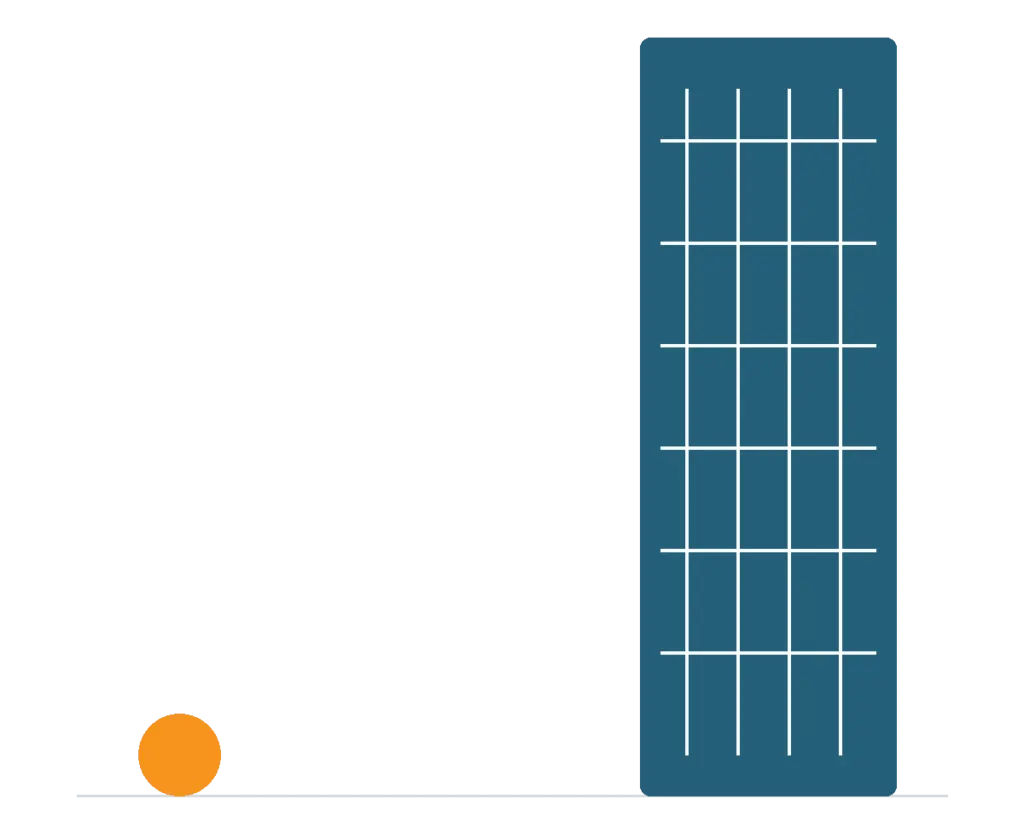
Here is the honest constraint every one of us actually works under. In a given day, most of the real work happens alone, in stretches of minutes, sometimes a couple of hours. With that much time and that much labor, you can only knock over a little domino. That is not a failure. That is physics.
So the first three lessons of Domino Theory are about matching force to the piece in front of you.
- LESSON ONE: Working alone, in the small windows you actually have, knock over the little dominoes. Do not apologize for their size. They are the ones you can move.
- LESSON TWO: Pull in a few coworkers and you can knock over a noticeably bigger domino than any of you could alone. Shared labor tips heavier pieces.
- LESSON THREE: Combine more people over a longer, sustained effort and you can take on a genuinely large domino, the kind that would have been impossible for any individual.
Those are good lessons. Most teams that run well have internalized them. But they are not the MBA-level lesson. They are still about applying force to whatever domino happens to be in front of you.
The Leadership Lesson: find the domino that sets up the next one
Here is where good operators and real leaders separate.
The leader’s job is not to find the biggest domino you can knock over. It is to find the smallest domino that makes the next one easier to knock over. And then the one after that.
Think about what Whitehead actually proved. He did not push over a skyscraper. He pushed over a two-inch tile that had been placed so that its fall did the work on the next piece, whose fall did the work on the piece after that. The genius was never in the force. It was in the setup.
You already have language for this, even if you have never connected it to dominoes.
In EOS and Traction, the discipline is called identifying the core issue, the “I” in the IDS process (Identify, Discuss, Solve).[3] Teams that skip it spend their meetings solving symptoms and wondering why the same problems keep standing back up.
Others call it root cause. Same idea. Do not treat the thing you can see. Find the thing underneath it that is holding everything up.

Engineers and quality people use the Five Whys.[4] You keep asking “why is that?” until the answers stop pointing sideways and start pointing down, to something foundational.
Every one of those tools is doing the exact same job. Each is a search for the easiest possible domino, the one small enough to move today that also happens to be the one propping up everything else. Find that piece and a fingertip does the work of a wrecking ball.
The Advanced Move: keep stacking, in order
Finding the first small domino is the intermediate skill. The advanced skill, the one that changes how a business performs, is refusing to stop there.
Do not just find the first domino. Map how it lines up against the second, and how the second sets up the third, and so on. You are not solving one problem. You are arranging a sequence so that a single, almost trivial-looking action releases a cascade.
This is why the best fixes so often look suspiciously simple from the outside. A leader tackles an “unachievable” sales goal and, weeks later, the number is moving, and the visible change was something small. An observer thinks, “That is all it took?”
No. That small fix was the first domino. What it actually did was let five other pieces fall in order, pieces that had been stuck standing because nothing upstream had freed them. The work was not in the size of the fix. The work was in seeing the order. That is the difference between being busy and being effective. Busy is knocking over whatever domino is loudest. Effective is knowing which domino, knocked over first, tips the other five for free.
People, Process, or Data: what the dominoes are usually made of…
There is one more gift EOS gives us here, and it turns the metaphor into something a team can act on Monday morning.
Nearly every core issue, when you dig to the bottom of it, turns out to be a people issue, a process issue, or a data issue.[3] I will not walk through all of the theory behind that. What matters for us is the practical part: big problems are rarely one domino. They are usually a small chain of two or three, and often one from each category.
Take the “unachievable” sales goal again. Get underneath it and you might find three dominoes leaning on each other.
- A people domino. Maybe a team member was never trained on the piece of the job that actually drives the number.
- A process domino. Maybe the handoff between marketing and sales is not dialed in, so good opportunities stall in the gap between two teams that each assume the other has it.
- A data domino. Maybe nobody is seeing the buying signals fast enough to act while they still matter.

Notice what happens when you lay those out as a chain instead of a pile. Train the person and the handoff still leaks. Fix the handoff and you are still blind to the triggers. But put them in order, and knocking over the data domino (surface the signal) makes the process domino (the handoff) easier to fix, which makes the people domino (the training) land on something real instead of theory. The skyscraper, the sales goal, was never the thing to push on. It falls on its own once the three small pieces beneath it go in sequence.
This is also where Domino Theory connects to the rest of how we think at Imagine IT. It is the same instinct behind the SATs of Successful Project Planning: aim before you fire. It is the engine behind continuous improvement, where each improved handoff sets up the next one. And it is what “up and to the right” actually looks like up close, a series of small, ordered wins that compound instead of a single heroic shove.
Why this matters for a team, not just a leader
You could keep Domino Theory as a private planning trick. But its real power shows up when a whole team can see the same chain.
When people only see the skyscraper, ownership gets murky. The problem is too big to belong to anyone, so it belongs to everyone, which means it belongs to no one. Meetings circle. Nobody can point to the piece that is theirs.
Draw the same problem as a line of dominoes and something changes. Now there is a people domino with a name on it, a process domino two teams share, and a data domino that IT can go make visible this week. People stop debating the skyscraper and start claiming their tile. “I have got the training piece.” “We will fix the handoff.” “Give me the trigger and I will act on it.” A connected chain invites ownership in a way a giant abstract goal never will.
That is the quiet leadership win. You did not just solve a problem. You gave the team a way to see their part in a larger sequence, and a reason to trust that their small tile actually matters to the big one.
Try this: the Domino Map
Here is a companion exercise you can run with your team on any stuck, oversized goal. We call it the Domino Map. (A filled-in sample is attached to this note.)
- Name the skyscraper. Write down the big domino, the outcome that will not move. Be specific.
- Ask why it is still standing. Use the Five Whys. Keep asking until the answers point down to something foundational, not sideways to another symptom.
- Sort the pieces into People, Process, and Data. Most stuck goals have at least one domino in two of the three. Label each one.
- Put them in order. This is the real work. Which domino, knocked over first, makes the next one easier? Arrange the chain so each fall does the setup for the next.
- Find today’s first tile. Identify the single smallest piece you can actually move in the time and with the people you have this week. Knock it over.
- Watch the chain, and re-map. After the first piece falls, look again. The order often reveals itself only once the first domino is down.
Keep the map visible. Give each domino an owner. Then let physics do what physics does.
The Takeaway
Leaders are paid to move big things. But you do not move a big thing by pushing on it. You move it by finding the small, ordered pieces that were holding it up, and knocking them over in sequence.
Stop staring at the skyscraper. Find the two-inch tile that starts the fall. Line up what comes next. And remember that the most valuable thing you do today might look, to everyone watching, like the smallest.
That is Domino Theory. It is not really about dominoes. It is about order.
Want to run this with your own team?
Download The Domino Map, a free 6-step worksheet for turning any stuck goal into a sequence of small, ordered wins. Includes a filled-in examples so you can see how it works before you try it yourself.
NOTES AND SOURCES
[1] Lorne A. Whitehead, “Domino ‘chain reaction,'” American Journal of Physics 51, 182 (1983) – the paper showing a falling domino can topple a successor roughly 1.5 times larger in each dimension.
[2] University of Toronto physics demonstration of Whitehead’s amplifier: with ~1.5x growth from a roughly two-inch domino, about the 29th domino reaches Empire State Building height. A later model by J.M.J. van Leeuwen (Leiden University) puts the theoretical maximum growth factor near 2x.
[3] Gino Wickman, “Traction: Get a Grip on Your Business” – source of the EOS “IDS” method (Identify, Discuss, Solve) and the People / Process / Data core-issue principle.
[4] The “Five Whys” root-cause technique, developed by Sakichi Toyoda and used within the Toyota Production System.