

“Ready. Fire. Aim.” works in a Western. In project planning? Not so much.
Too often, organizations dive into projects headfirst—well-intentioned, resource-laden, and completely off-target. The result? Weeks or months of effort, loads of tactical execution, and very little to show for it.
To help prevent that, we use a simple framework we call The SATs of Project Planning:
Strategy → Analysis → Tactical Execution.
This isn’t project management theory. It’s a practical mindset shift for leaders and teams alike. It’s also a powerful diagnostic: if something feels off, you can usually trace it back to a skipped “S” or a rushed “A.”
🎯 The SAT Framework: Plan Like a Leader
In its simplest form, SAT is about making sure you’re aiming at the right target—and not just moving fast and hoping for the best.
S – Strategy: Define the Goal
This is where every project must begin. It’s not a meeting. It’s a mindset.
The purpose of strategy is to ask:
- What are we trying to accomplish?
- Why are we doing this now?
- How does this support the business?
- What does success look like? (If you can’t see it upfront, you’ll struggle to hit it.)
And here’s the kicker: Strategy is the responsibility of leadership.
If you’re a C-level executive, this is your space. Don’t delegate it.
A – Analysis: Vet the Options
Once the why is clear, the how can begin.
Analysis is where we explore the options, consider the variables, assess the risk, and build the plan. This is typically owned by middle managers—those closest to the systems and staff who will bring the work to life.
Good analysis includes:
- Evaluating solutions and vendors
- Confirming assumptions
- Building a timeline and resource plan
- Stress-testing the proposed approach
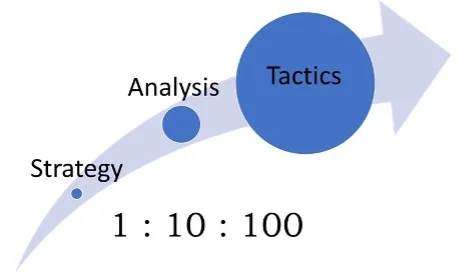
At Imagine IT, we often talk about the 1:10:100 Rule:
👉 1 hour of Strategy leads to 10 hours of Analysis, which sets up 100 hours of Tactical Execution.
Skip strategy? Those 100 hours might be wasted.
Even on the happy path, your time and investment multiply quickly. Make sure your aim is true.
You can see this principle in action in our visual below—where effort grows as you move forward, but accuracy depends on your origin point.
T – Tactical Execution: Deliver the Work
This is where things happen: systems go live, users get trained, dashboards get built, changes are rolled out.
But here’s the trap: many organizations start here.
They “just need a server” or “want a new CRM” and begin executing immediately.
Tactics belong to your frontline teams—implementers, builders, testers. But they rely on clarity and planning from above. Without it, even great execution falls flat.
⚠️ When Strategy is Off, Everything Drifts
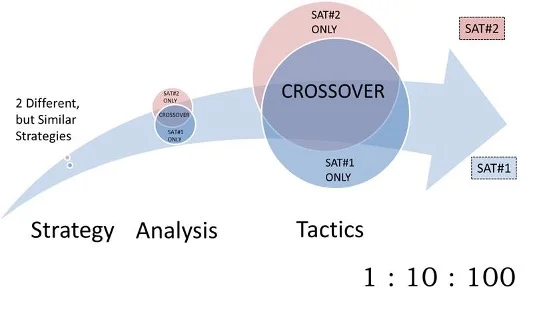
Let’s bring this to life with two real-world examples that show how strategy (or the lack of it) sets the entire trajectory:
❌ Bad Example 1: Right Work, Wrong Direction
Leadership skipped strategy and Analysis selected a physical server for a company that currently exists in one location, but is planning to expand geographically and leverage more remote workers.
The project team executed well—but the result was a location-bound solution that:
- Increased downtime risk
- Required extra disaster recovery planning
- Was harder to support and scale
Had the strategy been clearly defined upfront (e.g., cloud-first, remote-ready, scalable), the team could have analyzed and selected a hosted solution that aligned with future growth.
❌ Bad Example 2: Misaligned Success
A business chasing agility chose a well-respected CRM but neglected to define “success.”
Analysis focused on feature sets and reputation—but not integration.
The CRM didn’t connect with the company’s production management system.
The result? Double entry. Poor adoption. No clear ROI.
A missed strategic moment cost the business months of effort and momentum.
We illustrate this drift visually in the second image below. Even small strategy shifts can create major divergence over time, especially at the Tactics stage.
🧠 The Organizational Layering of SAT
Think of your org chart:
- C-Level Executives → Own the Strategy
- Directors/Managers → Lead the Analysis
- Teams & Vendors → Execute the Tactics
Each group has a role. Each role must stay in its lane.
Executives shouldn’t be rewriting Gantt charts. And project teams shouldn’t be defining business strategy.
When everyone plays their part, you create alignment, accountability, and better results.
💥 Conclusion: SAT Before You Act
Next time you’re gearing up for a major project, pause for just a second and ask:
✅ Have we defined Strategy?
✅ Have we completed real Analysis?
✅ Are we ready to Execute?
If not, you’re not ready.
Take the time. Respect the layers. Protect the process.
Because skipping SAT might get you moving faster—but only in the wrong direction.